Solving Factory Noise Problems... Without Noise Data
"Addressing factory noise issues without complete noise data can hinder the identification of noise sources, potentially leading to unnecessary increased improvement costs. Alternatively, post-improvement investments might prove ineffective, with noise levels not reducing as desired, resulting in wasted investment. Collecting and analyzing on-site data to develop noise reduction strategies is a cost-effective approach that yields genuine noise reduction and sustainable solutions to factory noise problems."
An employee from an industrial factory contacted our company, expressing the need to reduce machinery noise in the production area where workers are exposed to noise levels exceeding standards (Overdose). The client's available data included the 8-hour average noise level in the area and the dose received by employees (both exceeding legal limits). The client was seeking a company to reduce the machinery noise, with the condition that the contractor must guarantee post-improvement noise levels below 80 dBA.
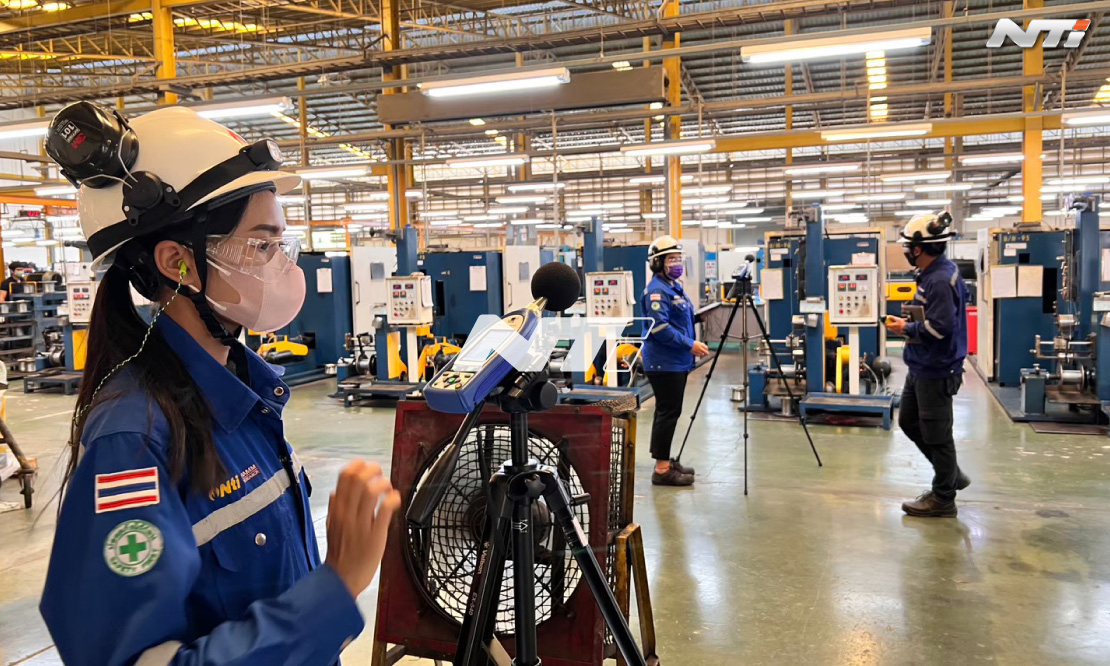
NTi's sound engineering team advised that while the client had receiver data, crucial information about the noise source or machinery was missing. This includes noise characteristics (Waveform), frequency (Octave Band), dominant frequency, impulse level, and peak level (Lpeak). All these data points are vital for designing noise reduction approaches and selecting appropriate soundproofing materials. However, the client indicated they did not wish to collect the recommended noise data, instead preferring a company that could solve the problem and guarantee results without additional data collection.
Addressing Noise Issues Without Source Noise Data: The Problem Lies Here
1) You Cannot Pinpoint or Definitively Identify the Source (Source Localization)
1.1) For a single machine, which part is generating the noise
1.2) With multiple machines, which one is the loudest or which ones need improvement
1.3) In adjacent areas with noise sources on both sides, how can you be sure that addressing one side will suffice, as the unaddressed side may still contribute to excessive noise levels
2) You May Incur Unnecessary Additional Costs
For example, unable to distinguish between direct sound and reverberation, you lack information on whether to use sound absorption methods for the building, sound insulation at the source, or both. This may lead to a scatter-gun approach or repeated ineffective attempts.
3) Unable to Select Appropriate Materials
4) Cannot Calculate Sound Attenuation or Reduced Noise Levels
5) When Necessary, Unable to Perform Noise Simulation
6) Cannot Evaluate Project Success
7) Problem-Solving Based on Guesswork, Without Principles or Rationale to Support Project Feasibility